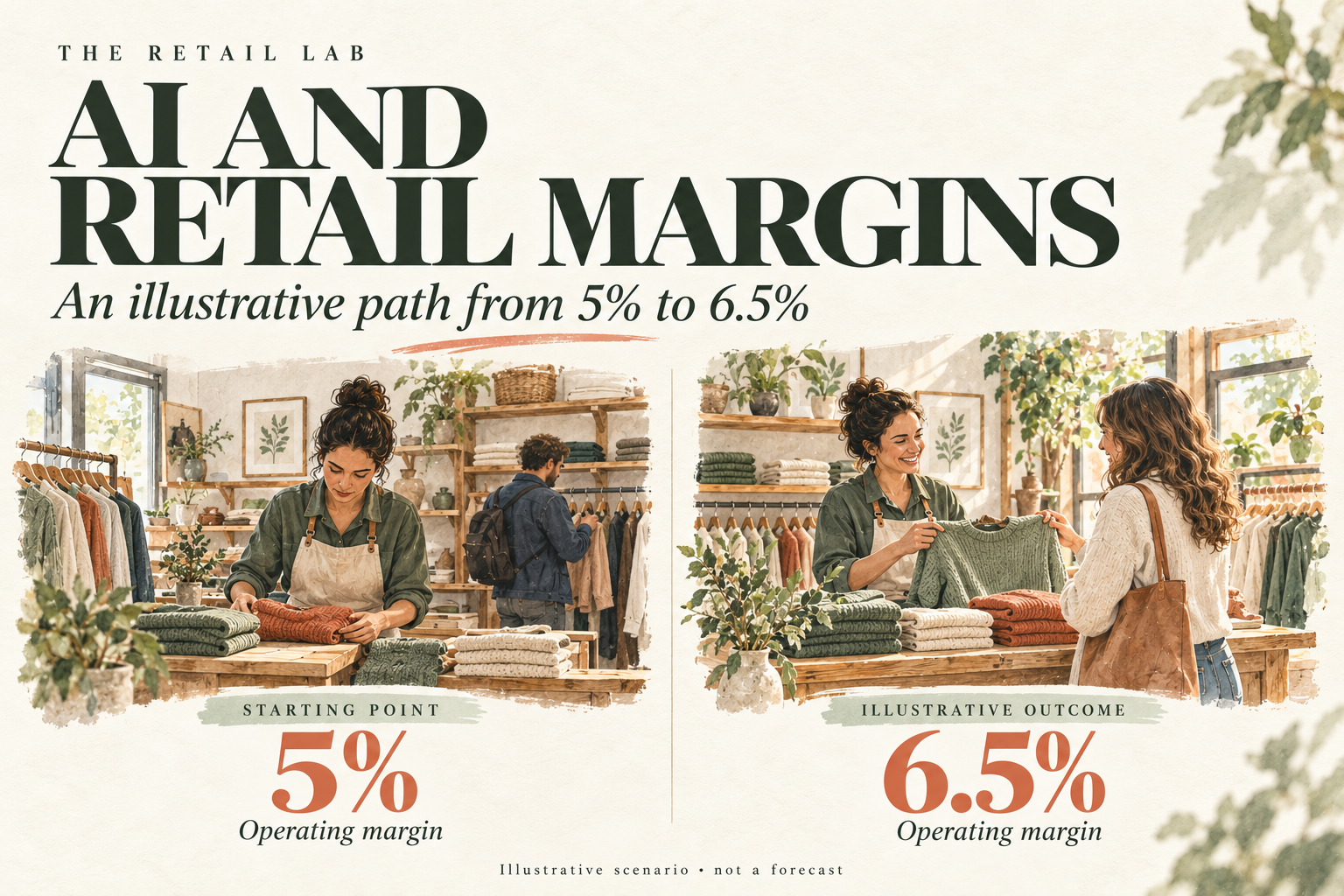
AI and retail margins: what could actually change?
A simple example of how higher sales and genuine cost savings could move a retailer’s operating margin from 5% to about 6.5%.
By The Retail Lab2 min read
AI partner
No vendor assumed
Status
Illustrative scenario · not a forecast
Announcement
Editorial illustration by The Retail Lab.
What could AI actually do for a retailer’s margin?
Higher sales are part of it. Better forecasting can also mean fewer markdowns, less waste and lower operating costs.
Take a hypothetical retailer with $10 million in annual sales and $500,000 in operating profit. That’s a 5% margin.
An illustrative scenario
Assume:
3% more sales, with 40 cents of each additional dollar left after variable costs: +$120,000
Separate annual operating savings: +$100,000
Annual AI and implementation costs, including training, change management and support: −$50,000
Operating profit becomes $670,000 on $10.3 million in sales. Margin moves from 5% to about 6.5%. That’s 34% more operating profit.
The savings have to be real
This is an illustration, not a forecast. You can’t count the same benefit twice.
Staffing savings might come from less overtime, avoiding additional hires or reducing headcount. Freeing up someone’s time alone doesn’t lower payroll.
That’s the question we explore at The Retail Lab: where could AI make a measurable difference in your business?
More Industry coverage
DoorDash / United States
In-app rollout · text and corporate ordering betas
DoorDash is bringing ordering into texts and workplace AI tools. For retailers, the useful test is whether easier ordering leads to accurate, profitable orders.
Very is using AI to decide which shopping prompts and offers customers see, and when. The early results are interesting. The bigger question is whether better timing can improve profit while making shopping easier.